Machine learning models assume that training and testing data share similar distributions. When this assumption breaks, model performance drops sharply, a phenomenon called negative transfer. For example, an image classifier trained on photos with clear backgrounds might fail when tested on images with cluttered backgrounds. In the context of Simulation-Based Inference (SBI), this challenge becomes especially critical: models trained on simulated experiments must generalize to complex, noisy, and often imperfect real-world observations. Domain adaptation techniques such as VIADA thus play a vital role in closing this simulation-to-reality gap, ensuring that inference models remain reliable and scientifically valid when transferred from the source simulated to the target empirical domains.
Unsupervised Domain Adaptation (UDA) addresses this challenge by transferring knowledge from a labeled source domain to an unlabeled target domain, where direct supervision is unavailable. The core idea is simple: if a model can learn representations that “look the same” across domains, then a classifier trained on simulated data should also perform well on real observations. In practice, this is often achieved by encouraging feature distributions from both domains to align.
Traditional UDA methods focus on aligning global feature distributions between source and target domains. However, this alignment can come at a cost: class-level structure is often not preserved, leading to overlaps between different classes after adaptation. For example, in digit recognition (e.g., MNIST), naïvely aligning domains may cause a “3” in the target domain to be confused with an “8” from the source. VIADA offers a solution to these typical shortcomings by combining variational inference and adversarial learning to maintain class-level consistency and achieve stable, domain-invariant representations.
A Hybrid of Variational and Adversarial Learning
VIADA builds upon the ADDA (Adversarial Discriminative Domain Adaptation) framework [Tze17A] and introduces a VAE-based pretraining phase [Kin22A] that learns structured latent representations across both domains. To implement this approach, VIADA follows three main steps:
Pretraining (VAE alignment):
A shared VAE learns probabilistic latent representations for source and target data, encouraging samples from the same class to cluster together regardless of domain. For example, all images of the digit “3”—whether from the source or target dataset—are mapped to the same region in the latent space.Adversarial adaptation:
The target encoder and discriminator engage in an adversarial game: the discriminator tries to tell whether a feature comes from the source (e.g., MNIST) or the target (e.g., USPS), while the target encoder learns to fool it, producing features that look like they come from the source domain while preserving their digit identity.Classification:
The pre-trained classifier labels the now-adapted target features. Since the target features for a “3” now look like source features for a “3”, the classifier correctly identifies the digit.
This three-phase process results in smooth, coherent latent manifolds where samples remain well-clustered by class while the domain gap is minimized (see Figure 1).
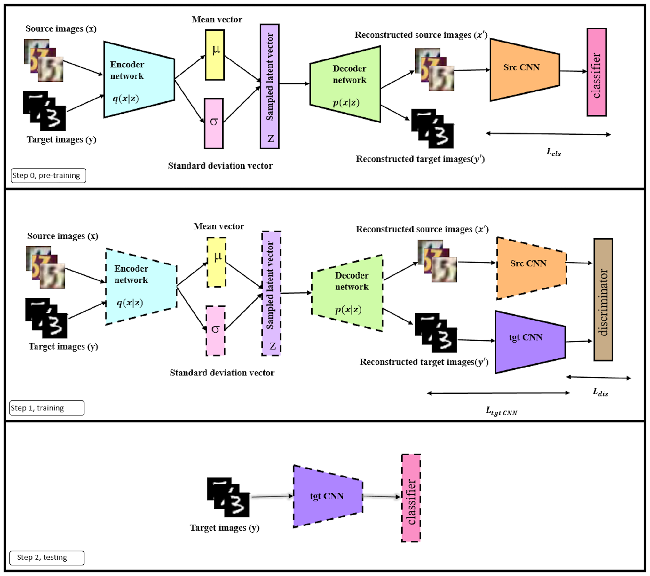
Figure 1: Overview of the VIADA architecture. A VAE first aligns class-level latent representations across domains. The target encoder then adapts these representations through adversarial training against a discriminator. Note that the classifier predicts class labels (e.g., digits), whereas the discriminator distinguishes between source and target domains. Dashed boxes indicate components with fixed weights during that phase.
Experimental Results
The authors evaluate VIADA on benchmark datasets including MNIST↔USPS (handwritten digits), SVHN→MNIST (Street View House Numbers to handwritten digits), and Office-31 (common objects in different office settings). In these experiments, the model is trained on a labeled source domain and evaluated on an unlabeled target domain. They also perform an ablation study to isolate the contribution of each component (VAE, discriminator, classifier). Across all settings, VIADA achieves results comparable to or better than existing state-of-the-art methods such as DANN and ADDA.
- On USPS→MNIST, VIADA reaches 92.3% accuracy using only 2,000 images (third overall) and 94.2% with the full dataset, ranking first among all compared methods.
- On Office-31, VIADA averages 80.7 % accuracy, outperforming all other compared methods under equivalent setups.
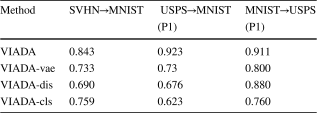
![]() Figure 2: Ablation study results on digit adaptation tasks. VIADA refers to the complete VIADA model; VIADA-vae uses only the variational pretraining stage; VIADA-disc applies adversarial training without VAE prealignment; and VIADA-cls relies solely on the classifier without adaptation. Results show that each component—VAE, discriminator, and classifier—contributes to the final accuracy, with the full model performing best across all benchmarks.
Figure 2: Ablation study results on digit adaptation tasks. VIADA refers to the complete VIADA model; VIADA-vae uses only the variational pretraining stage; VIADA-disc applies adversarial training without VAE prealignment; and VIADA-cls relies solely on the classifier without adaptation. Results show that each component—VAE, discriminator, and classifier—contributes to the final accuracy, with the full model performing best across all benchmarks. - The ablation study shows that accuracy drops significantly, by about 10–20 percentage points, when any stage of the process is removed. This demonstrates that each component contributes meaningfully and that the stages operate synergistically: VAE pretraining aligns classes in the latent space, adversarial adaptation closes the domain gap, and together they achieve the strongest and most stable performance.
To visualize the learned representations, the authors project the high-dimensional latent features of the target domain (MNIST) into a 2D space using t-SNE [Van08V], after training on the source (USPS). The resulting plots show clearly separated clusters of digit classes after adaptation, indicating that VIADA avoids class confusion and mitigates negative transfer (see Figure 3).
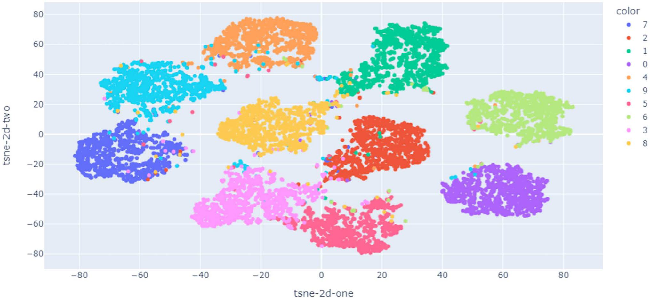
Figure 3: USPS –> MNIST target representation. VIADA maintains high class separability for the target domain.
Why It Matters
Robustness to distributional shifts is a fundamental requirement for any machine learning system deployed in the wild. SBI is a prime example where this is crucial: it can only achieve its goal if models trained on simulated data remain valid in the real world. Without effective domain adaptation, inference breaks down as soon as simulations diverge from reality.
VIADA demonstrates a principled way to close this gap. By merging variational inference and adversarial learning, it preserves class structure while aligning domains, enabling models to generalize from synthetic to empirical data.
Although this work focuses on general domain adaptation, it suggests a valuable future direction for SBI: bridging simulation and reality through structured, probabilistic representations. Exploring such approaches to tackle model misspecification could be key to ensuring trustworthy, reproducible insights across scientific and engineering domains.
